


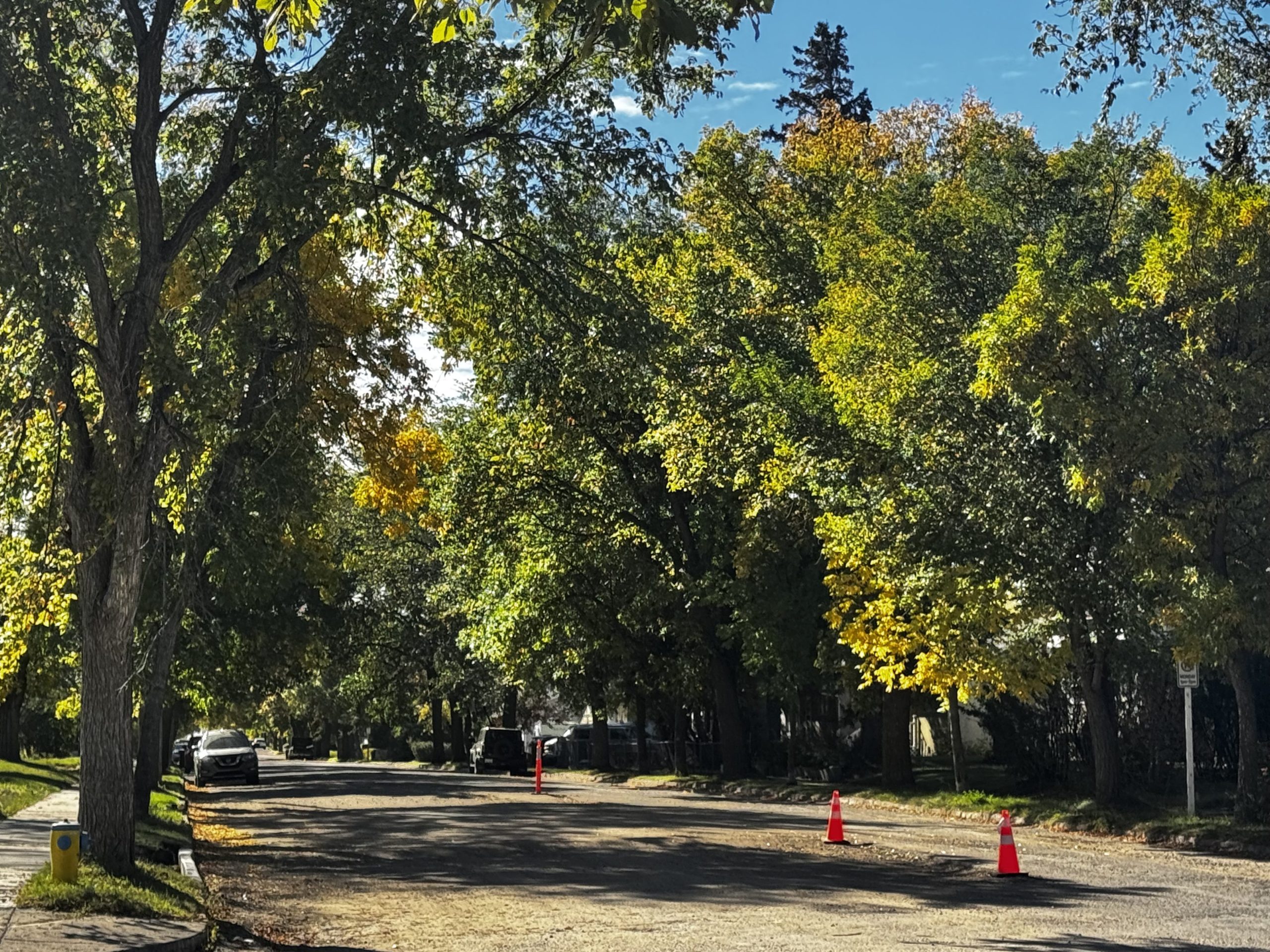
Pruning or removing a city tree without permission can now bring North Battleford residents a fine of at least $500 and a separate bill for damage.
Council’s newly-adopted Urban Forestry Protection Bylaw protects entire city trees, including branches and roots extending into neighbouring private yards.
A tree is covered if at least half its trunk is on city property, as determined by the city. That includes land the city owns, leases, controls or maintains.
Violation notices carry minimum penalties of $500 for a first offence, $750 for a second and $1,000 for subsequent offences.
Anyone who destroys a city tree without approval must pay the value assigned to it by the city, plus removal and replacement costs. Those who injure a tree without approval must pay related costs, including compensation for any loss in its value.
Residents unsure about a tree’s ownership can submit a service request. The bylaw allows the city to check its ownership and condition.
City permits are generally required to plant, prune or remove city trees. Permits are also required for digging, trenching, construction, changes to ground level or heavy equipment work on or near them, subject to exceptions.
The bylaw defines nearby work as work within six metres of the nearest point of the trunk, unless the city specifies otherwise.
Some activities are exempt unless the city has notified the person in writing that a permit is required.
Those exceptions include certain minor landscaping and seasonal lights, cords or decorations that do not injure the tree or create a safety hazard.
The rules restrict placing or parking vehicles, heavy equipment, machinery or construction materials on or near city trees without a permit. An exception allows equipment or materials on paved driveways, streets or paths, subject to city tree-protection restrictions.
Emergency work needed to address an immediate public safety risk is also exempt, but the city must be notified as soon as practicable.
The bylaw also lists “trees in back lanes” among its permit exceptions, without specifying which activities that provision covers.
The permit process includes a plan describing the work and measures to limit tree damage. The city can require a deposit, proof of insurance, payment of tree-related costs and protective measures.
Permit denials must be explained in writing. Permit holders must get city approval before making significant changes to the nature or scope of their work.
The city can recover inspection, site restoration and replacement-tree care costs in addition to fines. It cannot recover compensation for the same loss twice.
On conviction in court, fines can reach $10,000 for an individual or $25,000 for a corporation, with further fines of up to $2,500 a day for a continuing offence.
The city can order work stopped, protective measures installed or a site restored. Those orders can also apply to people who authorize or benefit from the work, and can be appealed to council.
The city is responsible for inspecting and maintaining city trees. The bylaw allows entry onto private land to protect those trees after reasonable efforts to notify the owner or occupant. Inspections must follow The Cities Act.
The bylaw stems from the city’s urban forest management plan. During council’s Sept. 28 review of an earlier draft, parks and recreation director Cheryl DeNeire said the city encountered about 10 cases a year of public trees being pruned or removed without permission, sometimes by contractors.
She said she did not consider it a major problem, but the city had no dedicated urban forestry bylaw.
“Whether you enjoy the shade from a tree keeping your house cool or we’re talking about environmental protection, our trees are very, very important to the community,” Mayor Kelli Hawtin said following that discussion.
—