


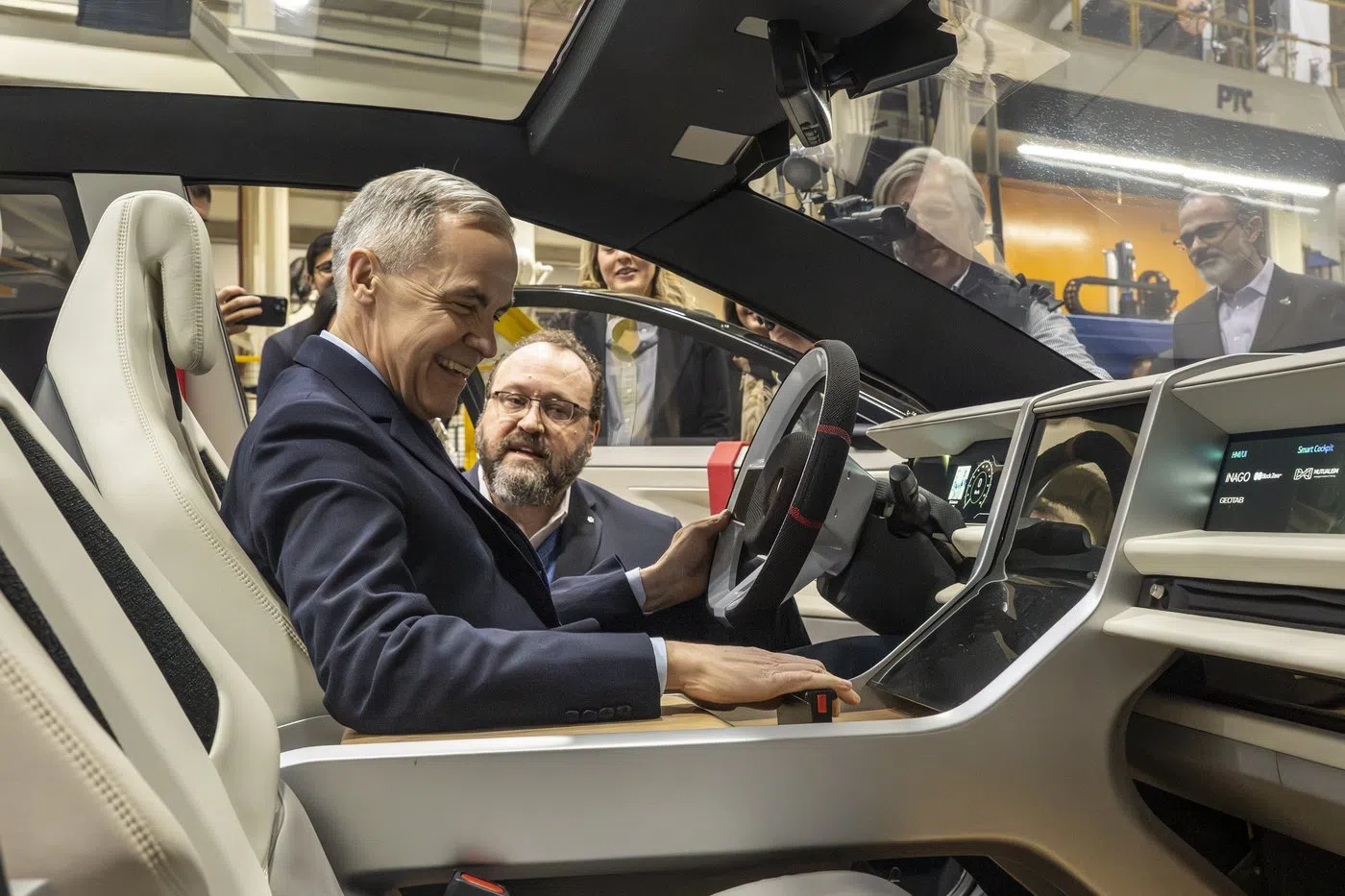
The federal government announced a suite of new electric vehicle policies Thursday, including the reintroduction of the popular rebate program and the elimination of the EV sales mandate in favour of stricter emissions standards for the auto sector. It’s a move that local dealerships, auto sector advocates and environmental groups are welcoming.
Hyundai North Battleford General Manager Steven Ulven said the new electric vehicle policies will help people understand the opportunity with EVs.
“How that changes their life and the way of commuting in the world. The incentives will hopefully entice the people that are looking into it and want to make an effective change for their lifestyle to do that easier,” said Ulven.
The announcement includes the restoration of the EV rebate program – with $2.3 billion to help Canadians cover the cost of a new EV — a new credit system to benefit automakers that produce vehicles in Canada, and a $1.5 billion investment in EV infrastructure like charging stations.
The EV purchase rebates, which will launch on Feb. 16, offer buyers $5,000 toward the cost of a fully electric vehicle and $2,500 toward plug-in hybrids. Those rebates will decrease every year until they’re phased out after 2030 — or until the money for the program runs out.
The rebates will only apply to vehicles which cost less than $50,000 and are imported from a country with a free-trade agreement with Canada — meaning the Chinese EVs Ottawa is allowing into the country won’t be eligible for the rebates.
Proponents of electric vehicles in Saskatchewan believe the new federal policy will be good news for adoption of the vehicles. Jerilyn Nixon, with the Saskatchewan Electric Vehicle Association, drives one of the 2,700 electric vehicles registered in the province. She hopes this leads to a turnaround.
“We did see a decrease in EV sales in Saskatchewan when the rebate went away. Some people have been waiting for the EV rebates to come back to buy,” she said.
The government said it’s hoping the rebate program will help put 840,000 new EVs on the road.
The new system discards the sales targets and instead will ratchet up existing tailpipe emissions standards, which the government expects will drive the adoption rate of EVs to 75 per cent of new sales by 2035, and 90 per cent by 2040.
Prime Minister Mark Carney said the new standard will set a maximum of 74 grams of carbon dioxide, or its equivalent, per mile. That’s down from the current federal tailpipe emissions standard of 172 grams per mile — a 56.9 per cent reduction.
Auto companies will be allowed some flexibility on meeting the new standards, including by improving fuel efficiency in gas-powered models, but the government said all companies will be required to increase EV sales over time in order to meet the standard.
Larry Heggs, with the Saskatchewan Auto Dealers Association, agrees with Ottawa tightening emission standards.
“Every manufacturer that’s been on their radar forever; we all know that those targets are going to continue to move. They need to continue to move,” said Heggs. “When you get rid of a mandate and actually allow us to work on a product that is the right thing for the consumers, then you’ll see that uptick.”
Meanwhile, Ulvers believes that hybrid technology will help people transition to fully electric as the years go by.
“The hybrids have a really good market share. People have embraced hybrid technology. It’s been around for a long time,” Ulvers said. “That is a very effective way to bring electrics into the mainstream and get people to understand their benefits. So, the hybrids are a nice segue into moving into a more fully electric option.”
–With files from CKOM and The Canadian Press
—